

Before You Call an Electrician, Here's What to Expect from Start to Finish
Before You Call an Electrician, Here's What to Expect from Start to Finish
Calling an electrician for the first time — or the first time with a new company — comes with a fair amount of uncertainty. What will they look at? How do they figure out what it costs? Will they need to open walls? What's the difference between a small job and a big one?
For homeowners in O'Fallon and the surrounding parts of St. Charles County, here's a clear-eyed walkthrough of what actually happens from the moment you make the call to the moment the job is done.
Step One: The Call and the Booking
When you call AAA Home Services at (636) 397-3200, the first conversation is about understanding your situation well enough to send the right person with the right tools. The dispatcher will ask you what's happening — a tripped breaker that won't reset, flickering lights, an outlet that stopped working, a panel that smells like something burned. Basic diagnostic questions, not an interrogation.
You'll get a scheduled window. For most standard electrical service calls in O'Fallon, same-day or next-day availability is the norm. If the situation is urgent — exposed wiring, a burning smell, a breaker that keeps tripping on a circuit running essential equipment — let the dispatcher know so they can prioritize.
Step Two: The Diagnostic Visit
The technician arrives and the first thing they do is look and listen before touching anything. A good electrician approaches a residential electrical issue the same way a doctor approaches symptoms: gather information before reaching for the tools.
This might include:
- Walking the panel with the homeowner to understand the circuit layout
- Testing outlets and switches with a multimeter
- Checking for voltage drop across a circuit
- Inspecting the panel for signs of overheating, corrosion, or improper wiring
- Looking at the grounding and bonding situation
This diagnostic phase is not about billing hours. It's about understanding the actual problem so the repair or recommendation is accurate. A technician who skips straight to telling you what it costs before figuring out what's wrong is selling, not diagnosing.
Step Three: The Scope and the Quote
Once the technician understands what's happening, they'll walk you through what they found and what the options are. The scope of the job falls into a few categories:
Minor repairs
Replacing a failed outlet, a switch, a GFCI receptacle, or a light fixture. These jobs are typically done the same visit. The parts are on the truck, the work takes 30 to 90 minutes, and you don't need to clear your schedule.
Circuit-level work
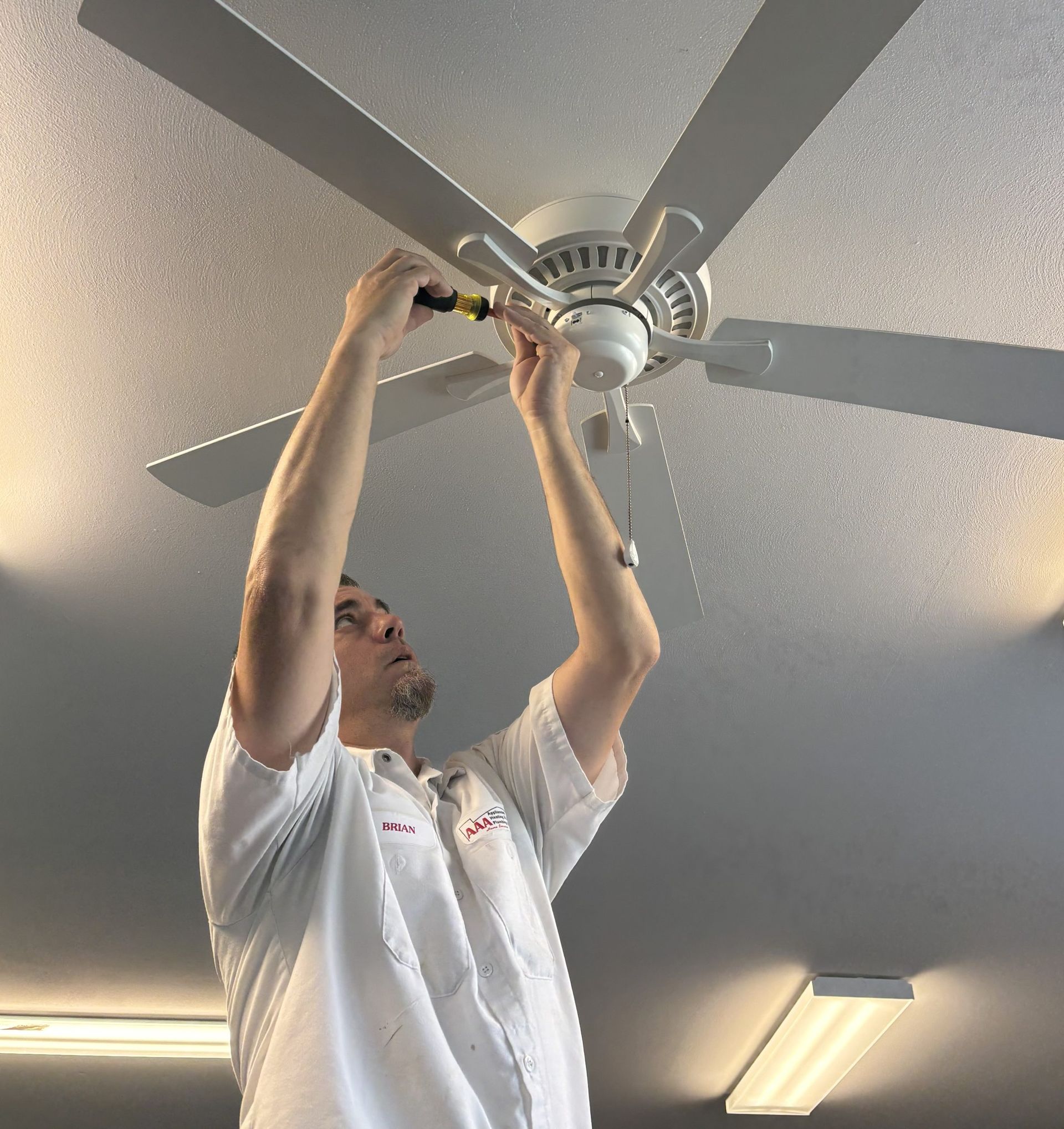
Adding a dedicated circuit for a new appliance, tracing and repairing a faulty run, installing a ceiling fan where there's no existing box — these jobs involve working inside walls or the attic and may take a few hours. Depending on scope, a permit may be required. Your technician will tell you if that's the case and what it means for timing.
Panel work
Panel upgrades, subpanel installations, or replacing a failing breaker panel are larger jobs that typically involve scheduling a dedicated appointment, coordinating with the utility company, and pulling permits. These are not same-day jobs, but they're also not emergencies that require you to make a fast decision. A reputable electrician gives you a clear written quote and a realistic timeline.
AAA's technicians do not work on commission, which matters in how jobs get scoped. The recommendation reflects what the home actually needs — not what generates the largest invoice. If a minor repair solves the problem, that's what gets recommended.
Step Four: The Work Itself
For jobs that go forward the same day, the technician will explain what they're doing before they do it. You won't find them disappearing into the attic for 40 minutes with no explanation. If something unexpected comes up — a wire that's run differently than standard, a junction box that was spliced incorrectly at some point — they'll bring you in on it before changing the scope.
When the work is done, they'll test everything in front of you: flip the breakers, verify the outlets, confirm the circuit performs as expected. No "it should be fine" and a quick exit.
Common Electrical Services in O'Fallon Homes
The older housing stock in parts of O'Fallon — particularly neighborhoods built in the 1970s through early 1990s — comes with its own common issues: aluminum wiring in some homes, undersized panels that haven't kept up with modern appliance loads, and two-prong outlets in bathrooms that need GFCI protection. Newer construction in O'Fallon's expanding subdivisions brings different questions: EV charger circuits, whole-home generator connections, and home office power demand.
Both end of the spectrum are familiar territory. If you've been putting off an electrical concern because you weren't sure it was worth a service call, it usually is. Electrical problems don't resolve themselves, and the cost of addressing them early is almost always less than addressing them after something fails.
You can review our full list of electrical services and reach us at (636) 397-3200. O'Fallon homeowners can also find local scheduling details on our O'Fallon service page. Or book directly through our contact page.
Frequently Asked Questions
Do I need a permit for electrical work in O'Fallon?
It depends on the scope. Replacing a like-for-like outlet, switch, or fixture generally does not require a permit. Adding new circuits, upgrading a panel, or making structural changes to wiring typically does. Your electrician is responsible for knowing the local requirements and will tell you when a permit is necessary before starting the job — not after.
How long does a typical electrical service call take?
A diagnostic visit and minor repair (outlet replacement, GFCI installation, tripped breaker investigation) usually runs 1 to 2 hours. More involved work — adding a circuit, fan installation with new wiring — is typically 2 to 4 hours. Panel work is scheduled as a separate, longer appointment.
What should I do if my breaker keeps tripping?
Note which circuit is tripping and what's on it. Unplug major appliances on that circuit and see if the breaker holds. If it trips with nothing connected, the breaker itself may be failing, or there's a fault in the wiring. If it trips only when loaded, the circuit may be undersized for current demand. Either way, this is a service call situation — a breaker that trips repeatedly is telling you something.
Are two-prong outlets a safety hazard?
Two-prong outlets lack the ground conductor required by modern code and present a shock and surge risk. They're legal to leave in place in older homes that were wired to the code of the time, but adding three-prong outlets without proper grounding is not code-compliant. The right fix is having a licensed electrician assess the circuit and upgrade it correctly — not swapping in a three-prong outlet without the wiring to back it up.
What's the difference between a circuit breaker panel upgrade and a service upgrade?
A panel upgrade replaces the breaker box itself — adding capacity, replacing failing breakers, or correcting wiring issues inside the panel. A service upgrade increases the amperage coming into the home from the utility, which requires coordination with AmerenUE and is a more involved process. Many homes going from 100A to 200A service need both.
How do I know if my home has aluminum wiring?
Homes built between roughly 1965 and 1973 in the U.S. may have aluminum branch wiring. A licensed electrician can identify it during an inspection. Aluminum wiring isn't necessarily dangerous on its own, but it requires aluminum-compatible devices and connections — a mismatch with copper-only devices is where problems develop. If you're in an O'Fallon home from that era and aren't sure, an inspection is worthwhile.