

Most homeowners don’t think about the wiring in their walls until something goes wrong. A breaker that trips every time the microwave and the toaster run at the same time. An outlet upstairs that feels warm to the touch. A faint smell of something burning that disappears before you can find the source. These aren’t quirks. They’re your house telling you the electrical system installed back when Carter was president can’t keep up with the way you live now.
If you own a home in O’Fallon, St. Charles, St. Peters, Cottleville, or really anywhere in our service area built before 1985, this is for you. (Already know you need work done? Start with our electrical wiring service page.) Here’s what to look for, what’s actually dangerous, and what an upgrade looks like in 2026.
Five Signs Your Wiring Is Past Its Prime
Some warning signs are obvious. Most aren’t. These are the ones our electricians find on inspections all the time, in homes where the owner had no idea anything was wrong:
- Breakers that trip more than once or twice a year on the same circuit. Breakers are designed to trip — that’s their job — but a circuit that keeps tripping is telling you it’s overloaded for the demand you’re putting on it. Adding a bigger breaker is the wrong fix and one of the most common DIY mistakes we see.
- Outlets or switches that feel warm to the touch. Not the lamp, not the device — the actual wall plate or the outlet face. That’s almost always a loose connection generating heat, and it’s how electrical fires start.
- Lights that dim when an appliance kicks on. If your kitchen lights pulse every time the fridge compressor starts, your service panel is fighting to keep up. Older homes were never wired with modern appliance loads in mind.
- Two-prong outlets throughout the house. Two-prong (ungrounded) outlets are a sign the original wiring is ungrounded — meaning surges and faults have nowhere safe to go. This is common in homes built before 1965 and a real concern if you’ve added electronics over the years.
- The faint smell of burning plastic with no obvious source. Trust your nose on this one. We’ve responded to enough late-night calls to say it plainly: if you smell something electrical and can’t find it, turn off the main breaker and call us. Don’t wait until morning.
Knob-and-Tube and Aluminum: The Two Big Ones
If your home was built before 1950, there’s a real chance some of the original knob-and-tube wiring is still in the walls. It worked fine for decades. But it has no ground, the rubber insulation gets brittle and crumbles, and it can’t safely handle modern loads. Most insurance carriers in Missouri will either refuse to write a policy on a home with active knob-and-tube or charge a significant premium until it’s replaced. If you’re trying to budget for a rewire, we broke the numbers down in this post on the cost of rewiring a house.
Aluminum wiring, used heavily in the 1965-1973 window, is a different problem. The metal expands and contracts more than copper, which loosens connections at outlets and switches over time. Loose connections heat up. Heated connections start fires. The fix isn’t necessarily a full rewire — sometimes specialized “pigtail” connectors at every device get you to safe — but it absolutely needs to be evaluated by a licensed electrician.
What an Upgrade Actually Involves
“Rewiring” sounds like a contractor needs to tear every wall in your house open. Sometimes that’s true for older homes with plaster-and-lath walls and no attic access. More often, an experienced electrician can fish new wire through existing chases, drop new circuits down through closets, and pull from the basement up — getting you to a fully modern system with surprisingly little drywall damage.
A typical AAA electrical upgrade for an average St. Louis-area home includes:
- Service panel replacement (200-amp is the modern standard)
- Grounding the entire system to current code
- Replacing two-prong outlets with grounded GFCI/AFCI protection
- Adding dedicated circuits for kitchen, laundry, bathroom, and HVAC equipment
- Whole-home surge protection at the panel
That last one — whole-home surge protection — is something we recommend on every panel upgrade now. Modern homes have thousands of dollars of electronics in them. A $300 surge device at the panel protects all of it. (If you’re vetting contractors for the panel work itself, here’s how to identify a legitimate panel upgrade specialist.)
This is exactly the kind of work we do every week. A repeat customer shared this after we ran new cabling for him:
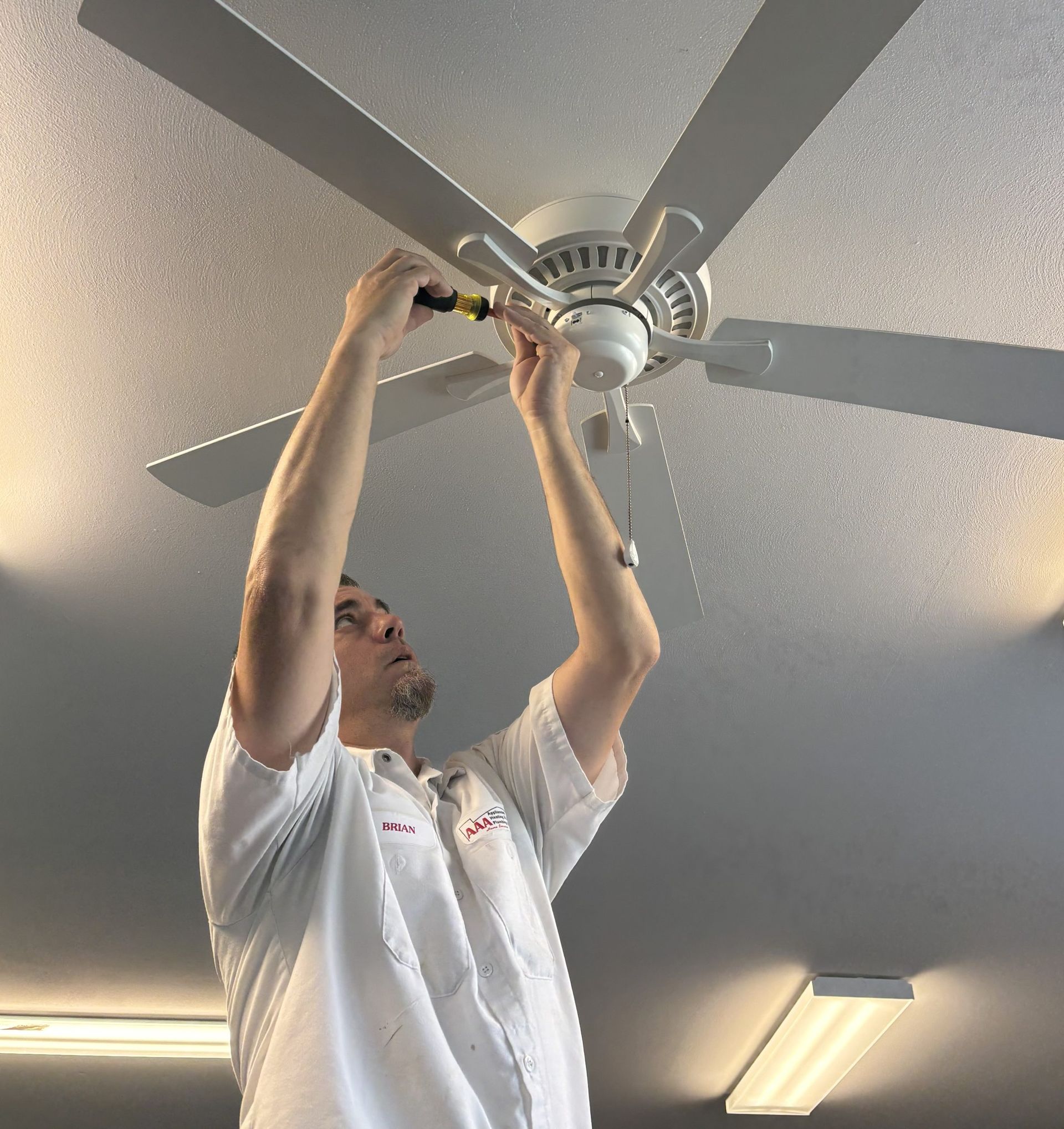
“I’ve used Brian on a couple of occasions, most recently to install a garage heater. He ran cabling from the basement to the garage and everything worked great. I have also used AAA for electrical and plumbing. Always first-rate work. You can’t go wrong with these guys.”
— Michael P.
The Hidden Cost of Waiting
Here’s the part nobody likes to think about. According to the National Fire Protection Association, electrical failures and malfunctions cause an estimated 46,700 home fires every year in the U.S., and the leading cause is wiring problems in homes built before modern code. Most of those homes had warning signs the owners didn’t recognize — or recognized and put off because the lights still came on when they flipped the switch.
An electrical safety inspection takes about 90 minutes and tells you exactly where you stand. If everything’s fine, you sleep better. If there’s a problem, you find it before it finds you.
Free Electrical Safety Inspections — Just Ask
AAA Electricians offers free in-home electrical safety inspections for homeowners across St. Charles County, St. Louis County, Warren County, and Lincoln County. Browse our home electrical FAQ if you’d rather read up first.
That trust compounds over time. Another homeowner put it this way after we’d handled several projects for her:
“Brian with AAA has been outstanding handling our various electrician needs. He has been resourceful, hard working and competent. We are so thankful to have had him handling our multitude of electrical needs. We cannot recommend him highly enough.”
— Mary L.
Our electricians are licensed, bonded, insured, and they don’t work on commission — so the assessment you get is honest and the recommendations are based on what your home actually needs, not what’s most expensive.
Call (636) 224-1790 to schedule. If you’re already noticing warning signs from the list above, mention that when you call — we’ll prioritize getting someone out fast.
The post Home Electrical Wiring 101: When It’s Time to Upgrade and Why It Matters appeared first on AAA Home Services.