

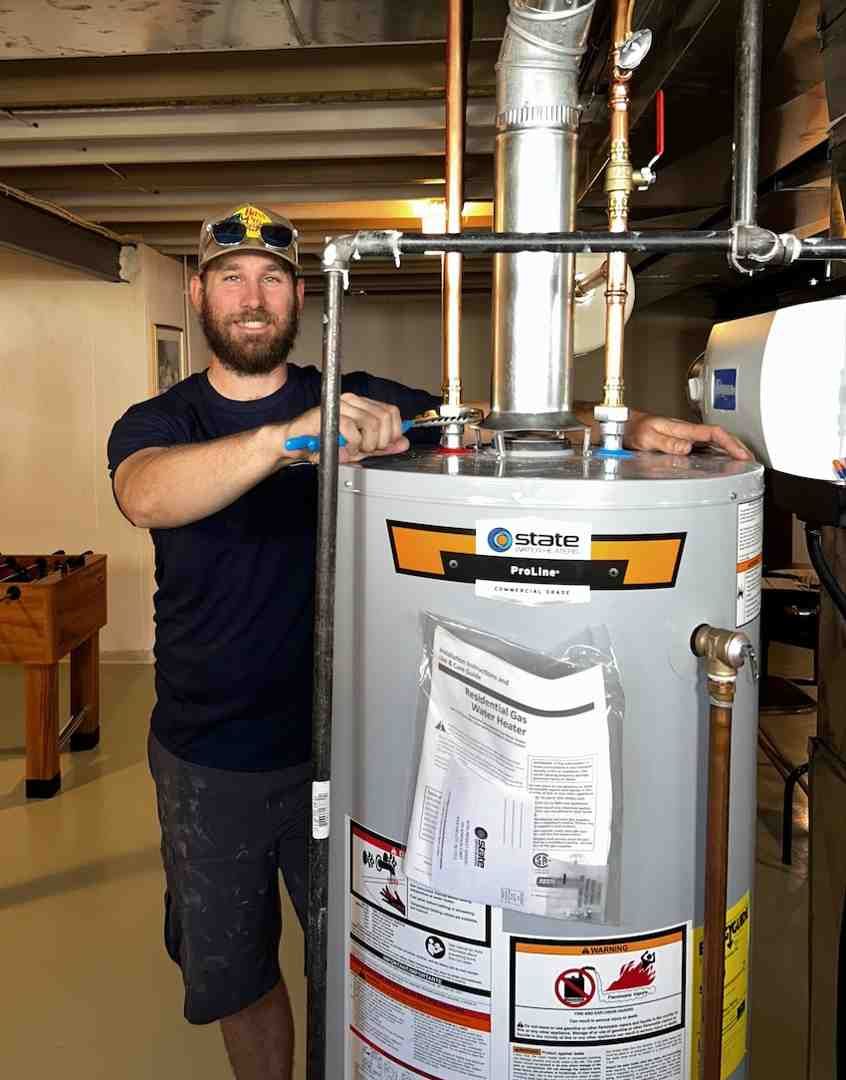

If you’re standing in front of a 14-year-old water heater that just started leaking, the last thing you want to do is spend three hours researching gallon capacities and recovery rates. You want hot water back. Today. But the size and type of unit you pick now is going to shape your utility bills, your morning showers, and your repair calls for the next decade — so it’s worth slowing down for ten minutes before you say yes to whatever the first plumber pulls off the truck. Our free water heater selector tool can walk you through the basics if you want a head start.
Here’s how we walk homeowners through the decision when they call us out to a house in O’Fallon, St. Charles, or anywhere across the metro. No upselling, no commission pressure — just the math.
Step One: Figure Out Your “Peak Hour Demand”
Water heater size isn’t really about how many people live in your home. It’s about how much hot water everyone uses in the busiest 60 minutes of the day. Most St. Louis families hit peak demand between 6 and 8 a.m. — back-to-back showers, the dishwasher running, somebody starting laundry on the way out the door.
A rough way to estimate: a shower uses about 10 gallons of hot water, a dishwasher about 6, a load of laundry about 7, and shaving or hand-washing about 2. Add up everything that typically happens in your household’s busiest hour, and you’ve got your peak demand number.
For a family of four where two showers, the dishwasher, and a load of laundry all happen between 6:30 and 7:30 a.m., you’re looking at roughly 33 gallons of hot water in one hour. That’s the number that drives every other decision.
Tank Water Heaters: Still the Right Call for a Lot of Homes
Conventional tank water heaters get a bad rap these days, but they’re still the most cost-effective option for most St. Louis County and St. Charles County homes. They’re cheaper to buy, cheaper to install, and a properly sized tank will outlast its warranty if you maintain it.
The trick is matching the First Hour Rating (FHR) on the tank’s label to your peak demand number. FHR is what the unit can actually deliver in the first hour of use, including reheat — and it’s not the same as the gallon capacity printed on the side.
Quick rule of thumb for tank sizing:
- 1-2 people: 30-40 gallon tank, FHR 45-58
- 2-3 people: 40-50 gallon tank, FHR 60-68
- 3-4 people: 50-60 gallon tank, FHR 70-80
- 5+ people: 75-80 gallon tank or two units
What this looks like in practice: when we say we’re not trying to sell you the most expensive unit on the truck, we mean it. Here’s how one Chesterfield homeowner put it after we installed her new tank:
“Did a great job and they were very professional. They outbid several other new water heater installers.”
— Debbie C., Chesterfield, MO
If you’ve got a soaking tub, a body-spray shower, or a teenager who treats the bathroom like a spa, bump up one size. We’ve seen plenty of homes where the original builder put in a 40-gallon tank that was fine in 2005 and is miserable now that the kids are in high school.
Tankless: Great for the Right House, Wrong for Some
Tankless heaters heat water on demand, so you never run out — at least in theory. They take up less space, last longer (often 20+ years), and use less energy because they’re not keeping 50 gallons hot all day for no reason.
The catch: tankless units are sized by flow rate in gallons per minute (GPM), not by tank size. A whole-house tankless for a family of four typically needs to deliver 7-9 GPM at a 70-degree temperature rise (which is what we’re working with through a Missouri winter when groundwater coming into the house is around 50 degrees).
That’s a lot. It means tankless installs in older St. Louis homes often require gas line upgrades, electrical work, or both — and that’s where the price tag jumps. We’re upfront about that on every quote. (For a real-world walkthrough of what a full conversion looks like, see our tankless install guide for St. Louis homes.)
Tankless makes the most sense when: you’ve got the gas capacity already, you’re running out of hot water with your current setup, you want to free up basement space, or you’re planning to stay in the home long enough for the energy savings to pay back the higher install cost (usually 8-12 years).
Hybrid Heat Pump Heaters: The Quiet Win
Heat pump water heaters pull warmth from the surrounding air to heat the water. If you’re wrestling with the budget side, our honest water heater replacement cost breakdown is worth a read. They’re 2-3 times more efficient than standard electric tanks, and there are still federal tax credits worth up to $2,000 on qualifying units in 2026.
They need a basement or utility room with at least 700 cubic feet of space and decent ambient temperature (which is most St. Louis basements). The downside: they’re slower to recover than gas tanks and they hum a little — not loud, but noticeable if your laundry room shares a wall with a bedroom.
One More Thing: Don’t Skip the Anode Rod Conversation
Whichever type you pick, ask the installer about the anode rod. It’s the sacrificial metal rod inside the tank that corrodes instead of the tank lining. Replace it every 4-5 years and you can stretch a 12-year tank to 18 or 20. Most homeowners have never heard of it because most plumbers don’t bring it up. We do — because we’d rather you keep the tank you have than buy a new one too soon.
Not Sure What Size You Need? We’ll Come Look — Free.
If your water heater is over 10 years old, leaking, or just not keeping up with your household anymore, AAA Plumbing and Water Heater Service offers free in-home assessments across St. Charles and St. Louis County. Our technicians don’t work on commission, so the recommendation you get is the one that actually fits your home — not the most expensive option on the truck.
That speed matters more than anything when you’re staring at a cold shower. A Wentzville customer put it plainly after we handled her replacement:
“Stuart and Robbie provide stellar service! They came out to help within a few days and I had a new water heater the next day!”
— Ann R., Wentzville, MO
Call (636) 397-3200 or schedule online. Same-day appointments are usually available.
The post What Size Water Heater Do You Need? A St. Louis Homeowner’s Guide appeared first on AAA Home Services.